The AI-Driven Trading Revolution
The AI-Driven Trading Revolution
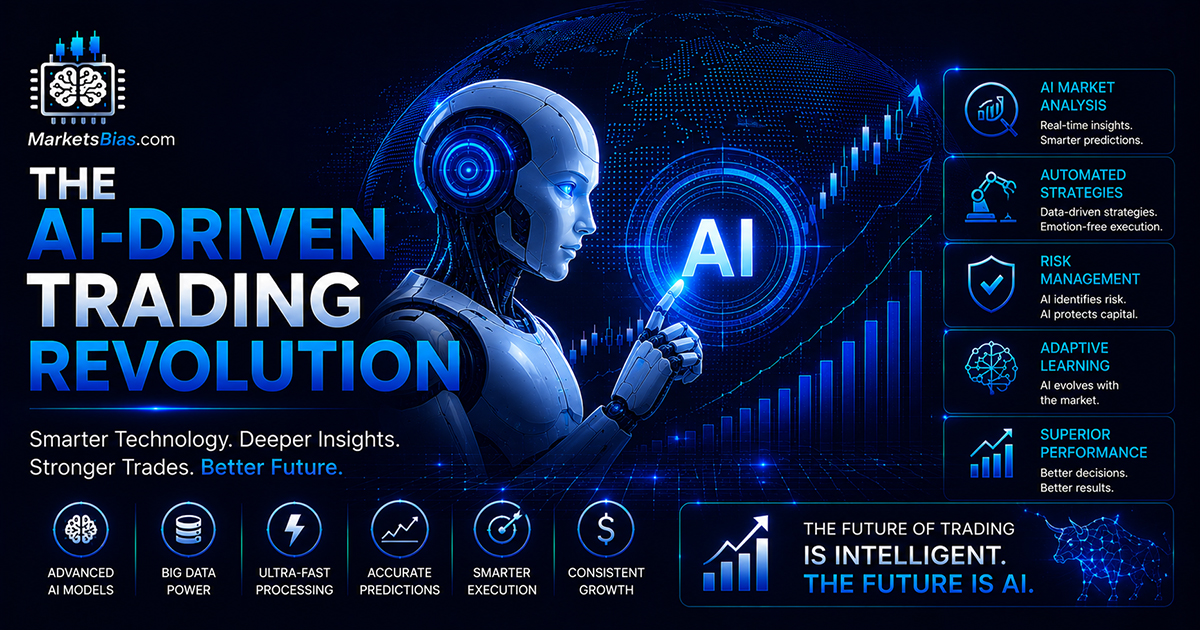
Introduction
Artificial Intelligence (AI) has revolutionized the trading world, opening up unprecedented levels of efficiency, accuracy, and speed in financial markets. By 2025, AI will handle almost 89% of the world's trading volume—changing everything from high-frequency equity trading to decentralized crypto ecosystems.
AI trading platforms leverage vast amounts of data—historical, real-time, and alternative—to identify patterns previously invisible to human traders. By processing datasets that range from news articles and satellite imagery to blockchain transactions, AI-powered systems not only execute trades at record speeds but also predict price movements with eerie accuracy.
The success of AI trading strategies becomes apparent in their capacity to outperform traditional methods. Algorithmic trading, powered by AI, has transformed trade execution through speed and precision. Current market statistics show that the AI trading market will reach a valuation of $35 billion by 2030, driven by the growing demand for data-driven insights and optimal trade execution.
Machine Learning & Deep Learning
Machine learning algorithms that learn from past and real-time data are at the core of AI trading. Trained on labeled data, supervised learning algorithms predict direction of price and minimize risk. With the ability to identify complex, non-linear patterns, neural networks have been a key component of strategies that produce high returns in foreign exchange and commodity markets.
NLP enables AI systems to process and interpret human language by reading earnings calls, financial news, and social media. Multimodal AI combines data from various sources—audio, text, and on-chain metrics—to produce holistic market predictions. This method allows platforms to improve trading signals by taking advantage of a range of information, thereby improving overall decision accuracy.
AI Trading Strategies
Sophisticated machine learning combined with predictive analytics and neural networks enables AI trading strategies to optimize financial trade decisions in modern markets. The strategies vary from quantitative to algorithmic trading as well as sentiment analysis and reinforcement learning to maximize returns and manage market risks.
These models study past data and use ongoing learning from new information to make future price predictions. Adaptive trading strategies adapt in real-time to minimize drawdowns during volatile market conditions.
Technical analysis alongside fundamental data and alternative data sources are combined to create comprehensive predictions.
AI Trading Case Studies
AI tools have become crucial for active credit managers challenging bond ranks, filling the gaps in data that lead to the discovery of attractive opportunities in complex fixed-income markets. Better investment outcomes and improved risk-adjusted returns propelled by enhanced decision-making.
Hedge funds using AI, such as those powered by Renaissance Technologies and High-Flyer Quant (DeepSeek) plug-in algorithms find minute inefficiencies in the market. Most of the Medallion Fund's multi-decade, 66% average annual returns are the result of cutting-edge AI strategies.
Companies such as BlackRock use AI to derive sentiment scores from news and social media to drive portfolio allocation and risk management. AI-augmented research has enhanced the accuracy of predictions by as much as 20%, allowing for more targeted asset allocation.
Companies such as Trade Ideas and eToro are democratizing trading by helping newbies and retail investors make better choices with their own AI-driven tooling. Increased user confidence and improved trading outcomes are commonly cited by platform users.
Conclusion
AI & the future of the AI trading landscape are changing. State-of-the-art technologies including deep & reinforcement learning, quantum computing & AI on the blockchain, are pushing the boundaries for a dramatic change in trading to be highly efficient, automated, and precise. Platforms that merge these technologies in both cases are facilitating execution enhancement; risk management and superior returns for both Institutional goliaths and retail Investors.
Future trends like personalized AI advisors, ESG trading, and blockchain-based decentralized trading will take it to another level, as the industry is bound to see further disruptions. With regulatory frameworks more and more aligned, the future of AI trading is bright provided stakeholders are keeping a close eye and consistently working towards ethical practices.
Source: liquidityfinder.com - Navneet Giri, a professional quantitative trader
How MarketsBias Puts This Revolution in Your Hands
The article vividly describes how AI is transforming trading—from hedge funds achieving 66% average annual returns to platforms democratizing access for retail investors. At MarketsBias, we're proud to be part of this revolution, making institutional-grade AI analysis accessible to every trader. Our AI Trading Assistant embodies the very technologies discussed: machine learning for pattern recognition, hybrid analysis that combines fundamental and technical data, and sentiment analysis to gauge market mood.
We deliver what the article identifies as the core benefits of AI trading: speed, precision, and freedom from emotional bias. In seconds, our platform processes vast amounts of data to provide you with a clear Market Bias, Key Fundamental & Technical Drivers, and Risk Management Guidelines for assets across Forex, Commodities, Indices, and Crypto. Just as the case studies show AI empowering better decisions, MarketsBias empowers you to trade with the clarity and confidence that comes from data-driven insights, not guesswork or emotion.
Try our AI Assistant at https://marketsbias.com for real-time AI Analysis.