Risk Management in Trading
Risk Management in Trading Every Beginner Must Understand
Why Risk Management Is Essential in Forex Trading
Forex trading involves leverage, which allows traders to control large positions with relatively small capital. While leverage can amplify profits, it also magnifies losses. This is why beginners often blow their accounts early. They trade large positions without understanding the downside risk.
Risk management in forex trading helps you limit losses, preserve trading capital, and stay in the market long enough to improve your skills. A trader who controls risk survives market volatility, unexpected news events, and emotional decision making. Without risk management, trading becomes gambling rather than a structured financial activity.
Understanding Risk Per Trade and Position Sizing
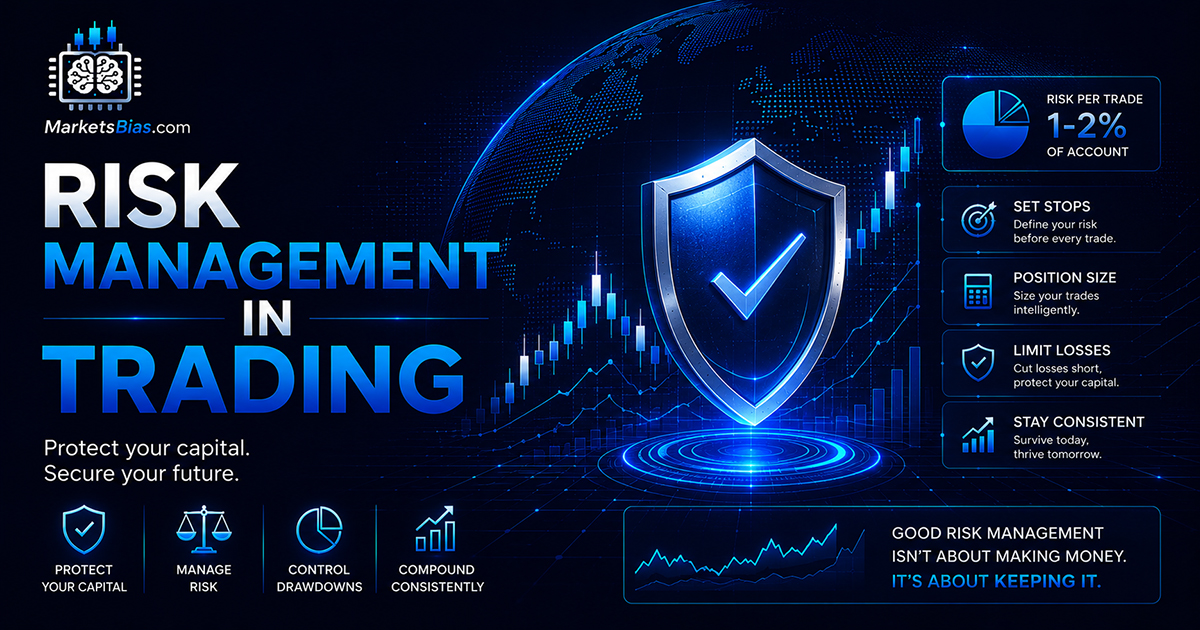
One of the first principles beginners must understand is how much to risk on a single trade. Professional forex traders rarely risk more than one or two percent of their total trading capital on any single position. This approach ensures that a series of losing trades does not wipe out the account.
Position sizing determines how large a trade you open based on your risk tolerance and stop loss distance. Many beginners make the mistake of choosing lot sizes based on potential profit instead of acceptable loss. Correct position sizing ensures that even if a trade hits the stop loss, the loss remains within your predefined risk percentage.
The Importance of Stop Loss Orders
A stop loss is a predefined price level where a losing trade is automatically closed. It is one of the most powerful tools in forex risk management. Beginners often avoid using stop losses because they fear being stopped out, but not using one exposes the account to unlimited losses.
Stop loss placement should be logical and based on market structure rather than random numbers. Traders often place stop losses below support levels in buy trades or above resistance levels in sell trades. This ensures the stop loss aligns with technical analysis rather than emotions.
Using stop losses consistently protects your capital and removes the need to monitor trades constantly. It also enforces discipline, which is essential for long term forex trading success.
Leverage and Risk Management
Leverage is a double edged sword in forex trading. While it allows traders to open larger positions, excessive leverage is one of the main reasons beginners fail. High leverage increases exposure and can wipe out an account quickly during volatile market conditions.
Effective forex risk management involves using conservative leverage, especially when starting out. Lower leverage provides more breathing room and reduces emotional pressure. As experience grows, leverage can be adjusted carefully, but it should never compromise account safety.
Risk to Reward Ratio
The risk to reward ratio compares the potential loss of a trade to its potential profit. A common approach in forex trading is to aim for a minimum risk to reward ratio of one to two. This means risking one unit to potentially gain two units. Even if you win only half of your trades, a favorable risk to reward ratio can keep you profitable. Beginners should focus more on maintaining good risk to reward setups rather than chasing high win rates.
Managing Risk During High Volatility
Forex markets can become extremely volatile during economic news releases such as interest rate decisions or employment reports. Spreads may widen, slippage can occur, and price movements can be unpredictable. Traders should reduce position sizes or avoid trading during major news events until they gain more experience. Adjusting risk exposure during high volatility is a key part of effective forex risk management.
Building a Simple Risk Management Plan
A basic forex risk management plan should define risk per trade, maximum daily loss, preferred leverage, and acceptable drawdown levels. It should also include rules for when to stop trading, such as after a series of losses.
This plan should be written down and reviewed regularly. Beginners who treat trading like a business rather than a hobby develop better habits and achieve more consistent results.
Conclusion
Risk management in forex trading is not optional. It is the foundation that supports every successful trading strategy. Beginners who focus on protecting their capital, controlling leverage, and managing emotions have a far higher chance of long term success.
Forex trading rewards patience, discipline, and consistency. By mastering risk management early, traders can survive market challenges, learn from mistakes, and gradually build confidence and profitability over time.
Source: ONSAFX. Ethan Walker, Financial writer
How MarketsBias Builds Risk Management Into Every Trade
The article makes it clear: risk management is not optional—it is the foundation of survival and success in trading. At MarketsBias, we've built this principle directly into our AI Trading Assistant. Our service doesn't just provide trade ideas; it delivers essential Risk Management Guidelines alongside every analysis, helping you define risk per trade, set logical stop loss levels, and determine appropriate position sizing based on market structure.
By combining this with a clear Market Bias and Actionable Trading Insights, we remove the guesswork and emotional pressure that lead to overtrading or misusing leverage. Whether you're trading Forex, Commodities, Indices, or Crypto, our assistant helps you apply the disciplined, rules-based approach that the article recommends—protecting your capital first, so you can trade with clarity, not emotion, and stay in the game for the long term.
Try our AI Assistant at https://marketsbias.com for real-time AI Analysis.