Common Trading Mistakes
Common Trading Mistakes and How to Avoid Them
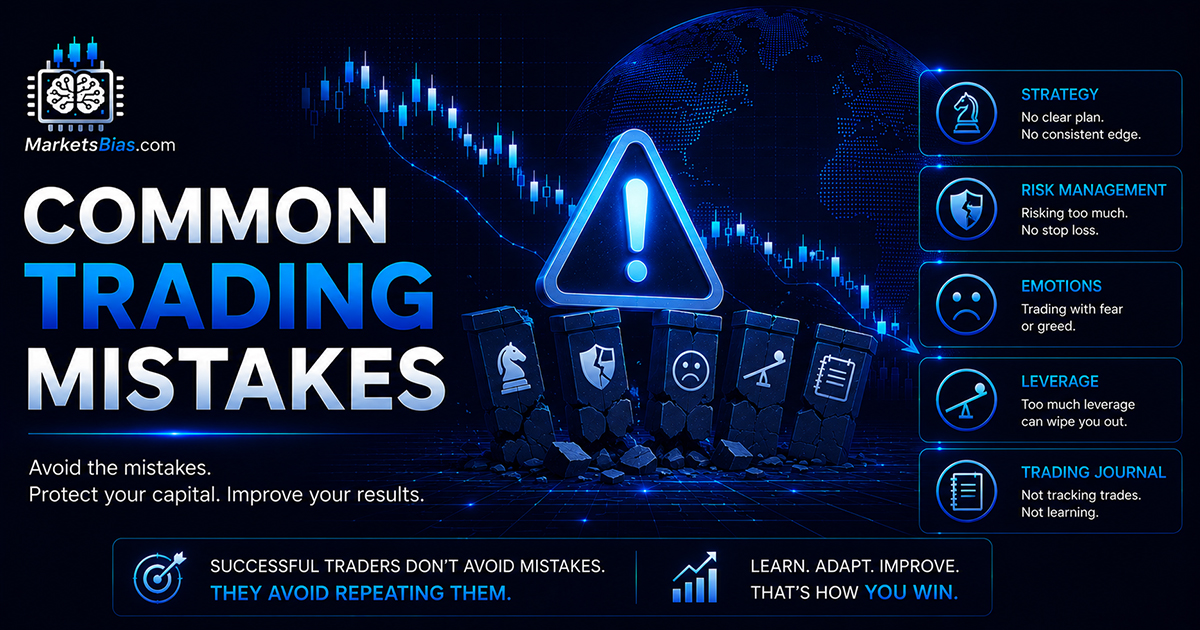
Trading Without a Clear Strategy
One of the biggest mistakes in trading is entering the market without a defined trading strategy. Many traders place trades based on instinct, social media tips, or short term excitement rather than a structured plan. Without a strategy, traders lack consistency and cannot evaluate what is working and what is not.
A solid trading strategy defines entry rules, exit rules, risk levels, and preferred market conditions. It may be based on technical analysis, fundamental analysis, or a combination of both. Traders who follow a strategy are less likely to act emotionally and more likely to remain disciplined during market fluctuations.
Poor Risk Management in Forex Trading
Ignoring risk management is one of the fastest ways to lose money in the every market. Many traders risk too much on a single trade, hoping for quick profits. When the trade moves against them, losses escalate quickly and accounts can be wiped out.
Proper risk management means limiting the percentage of capital risked on each trade, typically between one and two percent. Using stop loss orders is essential to control downside risk. Successful traders focus on protecting capital first and profits second.
Overtrading the Forex Market
Overtrading occurs when traders open too many positions, trade too frequently, or force trades when there are no clear setups. This often happens due to boredom, overconfidence, or the desire to recover losses quickly.
In trading, more trades do not equal more profits. Overtrading increases transaction costs, emotional stress, and the likelihood of making impulsive decisions. Many traders experience losses simply because they traded too much rather than too little. Avoiding overtrading requires patience and selectivity. Traders should wait for high probability setups that align with their strategy and avoid trading during low quality market conditions.
Letting Emotions Control Trading Decisions
Emotional trading is one of the most common trading mistakes. Fear, greed, frustration, and excitement can all interfere with rational decision making. Traders may close winning trades too early out of fear or hold losing trades too long hoping the market will reverse.
Emotions often intensify after a losing streak or a large win. This can lead to revenge trading, where traders attempt to win back losses by increasing position size or abandoning their strategy.
Developing emotional discipline is essential in trading. Using predefined rules, journaling trades, and accepting losses as part of the process can help traders maintain emotional balance.
Misusing Leverage in Forex Trading
Leverage is a powerful tool in trading, but it is also dangerous when misused. Many traders use excessive leverage because it allows them to control large positions with a small amount of capital. While this can amplify profits, it also magnifies losses.
High leverage combined with poor risk management often leads to rapid account depletion. Many beginners fail to realize that leverage should be used conservatively, especially during volatile market conditions. The best approach is to use leverage as a tool, not a shortcut. Traders should choose leverage levels that align with their risk tolerance and strategy rather than chasing large profits.
Ignoring Fundamental Analysis
Some traders rely solely on technical analysis and completely ignore economic data and news events. While technical analysis is valuable, ignoring fundamentals can expose traders to unexpected volatility.
Interest rate decisions, inflation data, employment reports, and geopolitical events can cause sharp price movements in the market. Traders who are unaware of these events may be caught off guard by sudden market swings.
Successful forex trading often involves understanding both technical and fundamental factors. Even traders who focus on charts should be aware of major economic releases that can impact price behavior.
Chasing the Market Instead of Waiting for Setups
Chasing price movements is a common mistake, especially during fast moving markets. Traders see a currency pair moving strongly and enter late, hoping to catch the trend. More often than not, the move is already exhausted, and the market reverses.
This behavior is driven by fear of missing out. It leads to poor entries and unfavorable risk to reward ratios. Forex trading rewards patience and timing, not impulsive action. Waiting for price to return to key levels or align with strategy rules increases the probability of success. Missing a trade is always better than entering a bad one.
Not Keeping a Forex Trading Journal
Many traders fail to track their trades, which prevents them from learning from mistakes. Without a trading journal, it is difficult to identify patterns, strengths, and weaknesses in trading behavior.
A trading journal should include entry reasons, exit reasons, emotional state, and trade outcomes. Over time, this data provides valuable insight into what works and what needs improvement. Consistent journaling transforms trading from guesswork into a structured learning process.
Conclusion
Forex trading success is not about avoiding losses completely, but about minimizing mistakes and managing risk effectively. Most traders fail not because the market is unfair, but because they repeat the same errors without addressing their root causes. By understanding common trading mistakes and applying disciplined solutions, traders can improve consistency, confidence, and long term performance.
Education, patience, and self awareness are the foundation of profitable trading. When traders focus on process rather than short term outcomes, they place themselves in a stronger position to succeed in the dynamic world of trading.
Source: ONSAFX. Ethan Walker, Financial writer
How MarketsBias Keeps You Disciplined
The article rightly identifies that emotional trading, overtrading, and ignoring fundamentals are among the most common and costly mistakes. At MarketsBias, our AI Trading Assistant is built to protect you from these very pitfalls. By delivering a clear, data-driven Market Bias and Actionable Trading Insights, we remove the guesswork and emotional pressure that lead to impulsive decisions.
Our platform ensures you never trade without a plan. It provides a structured analysis that includes Key Fundamental & Technical Drivers, Risk Management Guidelines, and specific Trading Recommendations for assets across Forex, Commodities, Indices, and Crypto. This keeps you focused on high-probability setups, helping you avoid chasing the market or misusing leverage. With MarketsBias, you trade with clarity, not emotion. Turning discipline from a challenge into your greatest advantage.
Try our AI Assistant at https://marketsbias.com for real-time AI Analysis.